
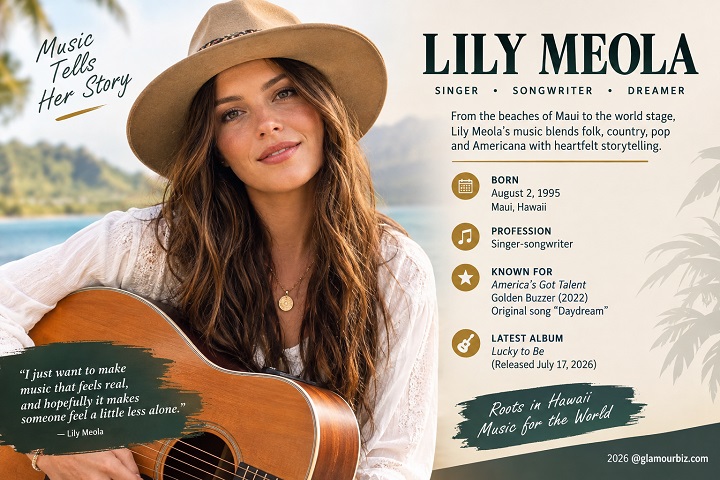
You probably know Lily Meola from one clip. She's standing on the America's Got Talent stage, singing a song called "Daydream," and Heidi Klum can't hold it together and slams the Golden Buzzer. That clip has been watched millions of times, and for most people, that's the whole introduction. Talented singer, big moment, done.
Except that's maybe 5% of who she actually is. By the time she walked onto that stage, Meola had already put in more than ten years in music. She grew up on Maui around a ranching culture most people don't even know exists in Hawaii, sang backup vocals for producers who've worked with some of the biggest names in the industry, and at one point turned down a record deal to take care of her dying mother. None of that fits into a three-minute clip. So here's a look at four parts of her story that usually get skipped over.
Lily Meola's Paniolo Roots: How Hawaiian Cowboy Culture Shaped Her Country Sound
Say "Hawaii" to most people, and they'll picture beaches, surfboards, and maybe a ukulele. Cowboys don't usually come to mind. But Hawaii actually has a real ranching history, and it goes back further than a lot of people realize.
The paniolo—Hawaii's version of the cowboy—dates back to the 1800s, when Spanish and Mexican vaqueros were brought over to handle cattle on the islands. Over the decades that culture mixed with local Hawaiian traditions and turned into something you genuinely can't find anywhere else. Maui, where Meola grew up, still has a working ranching scene, and country music has been popular there for generations because of it.
That's the world Meola was raised in, and honestly, it explains a lot about her sound. She writes country and Americana, but it doesn't sound like it's coming from Nashville or Texas. There's a warmth to it, almost a soulfulness, that feels tied to where she's from rather than where the genre usually comes from. She's brought this up herself in interviews: how country music has deep roots in Hawaii because of the ranching scene and how growing up around that made the genre feel natural to her long before she ever thought about a music career. It's a small thing that a lot of listeners probably miss. Plenty of artists pull from country and folk, sure. But not many can point to an actual cowboy tradition rooted in the middle of the Pacific Ocean as part of their musical DNA.
Before the Spotlight: Lily Meola's Years as a Hidden Backup Singer for Legends
Here's something most people don't know: Meola was working in the music industry long before AGT, just not in the way you'd expect. For a stretch of her childhood, she was actually homeschooled at producer Bob Rock's house. If that name doesn't ring a bell, he's produced records for Michael Bublé and Nelly Furtado, among others. And instead of just hanging around the house while the adults worked, Meola ended up contributing background vocals to some of those sessions.
Think about that for a second. She wasn't chasing a solo career at this point. She was just around, learning by proximity, picking up things about how real records actually get made that most young singers never get close to.
The list of people who shaped her during this time is honestly kind of wild. Jackson Browne acted as her first songwriting coach. She sang backup on Jamey Johnson's Christmas Song EP. And then there's Willie Nelson. Her family knew the Nelsons personally, and one night, when she was doing little gigs at a local café as a kid, Willie showed up and sang "Crazy" with her. That relationship stuck, and years later they recorded a duet together, "Will You Remember Mine," which ended up on his 2013 album.
What gets me about this part of her story is how quiet it all was. She wasn't building a following. There was no camera, no viral moment, nothing to promote. She was just learning from people who'd already spent decades figuring out the craft. That kind of apprenticeship is rare these days, and it probably explains why her voice already sounded so developed even in her earliest performances.
Lily Meola Walked Away From a Record Deal to Care for Her Dying Mother
This is the part of her story that's hardest to read and also the one she's talked about most openly. Right before AGT, Meola had a record deal within reach. That's the kind of thing artists spend years working toward. But around the same time, her mom was diagnosed with cancer.
She stepped away from the deal to become her mother's full-time caregiver. That's not a small thing to give up. Deals like that don't come around twice, and most people in the industry would tell you not to walk away at a moment like that. But she did it anyway, and she's said more than once that she doesn't look back on it as a loss. If anything, she calls it a kind of blessing, because it meant she got more time with her mom before she passed away in 2020.
That loss is basically the heart of "Daydream." She wrote the song while processing her grief, as a way to honor her mom, and when she performed it on AGT, she dedicated it to her right there on stage. You could feel that the judges weren't just reacting to a good voice. They were reacting to something real and unfiltered. Knowing this backstory changes how you hear her music. She's not writing from some safe distance. She's writing from an actual, lived experience of loss and sacrifice, and that's probably why it lands the way it does.
Lily Meola and Matt Meola: Hawaii's Sibling Duo of Music and Surfing
One more thing that doesn't come up much: Meola's brother, Matt Meola, is a pretty well-known professional surfer, sponsored by Turtlebox and respected in the surfing world for pushing what's possible with aerial tricks. The two of them grew up together on Maui, same house, same island, same upbringing. And somehow they ended up in completely different worlds.
Lily gravitated toward music early on. Matt found his thing in the water. It's a funny contrast when you think about it, two siblings raised in the exact same environment who ended up expressing themselves in totally different ways, one through songwriting and performance, the other through waves and boards.
But there's a shared thread underneath it. Both of them talk about growing up surrounded by nature and a tight-knit island community, and you can hear it in how they each describe their careers. There's a similar down-to-earth quality in both of them, something that feels like it comes from where they grew up rather than what they've accomplished since.
It's a minor detail in the bigger picture of her career, but it adds something. She didn't just come from a musical household. She came from a family that clearly wasn't scared to chase something unconventional, whether that meant a melody or a wave nobody else would try.