
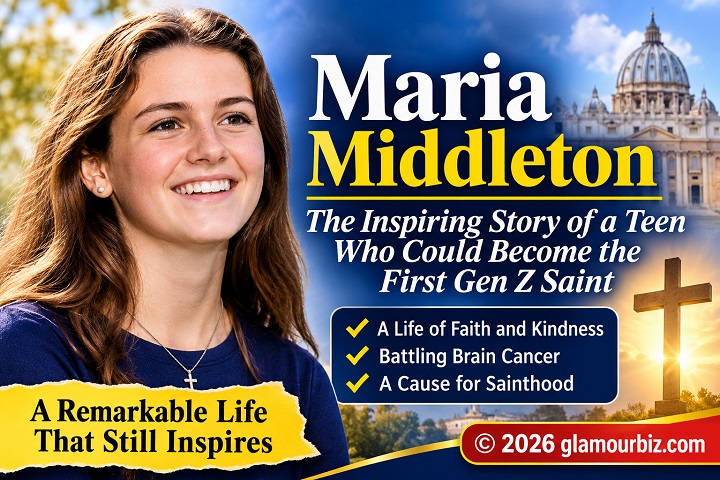
Some stories begin with a headline. Maria Middleton's begins with a homemade card. When she was five, a few days before Mother's Day, she vanished into her room to make one for her mother, Susan. Susan waited happily. Maria was already an articulate child who spoke in full, careful sentences, and her mother couldn't wait to see what she had written.
Nearly six years after Maria's death, that same girl is at the center of a conversation among America's Catholic bishops. In November 2026 they voted to advance her cause for sainthood, which could make her the first saint of Generation Z. That is a heavy claim to attach to someone who died at eighteen, so it is worth slowing down to ask who she actually was.
A Precocious Girl from Doylestown: Maria Middleton's Childhood, Personality, and Faith
Maria was born on September 10, 2002, in Doylestown, Pennsylvania, a Bucks County town just north of Philadelphia. She grew up with the things most teenagers care about: the music, the friendships, and the small obsessions. Alongside those ordinary interests sat something less common: a deep commitment to her Catholic faith.
That faith was not decoration. Those who have written about her describe a young woman known for her devotion and her service to the people around her. It is a rare thing to notice others at fifteen or sixteen, when most of us are fully occupied with ourselves.
The five-year-old with the Mother's Day card and the teenager who gave her time to others turn out to be the same person. The precocious child grew into someone who aimed her words and energy at something larger than herself.
Serving Others Through Illness: A Brain Tumor, a Journal, and Two Words, "Think Hope"
In January 2019, during her sophomore year of high school, Maria was diagnosed with an inoperable brain tumor. She was sixteen. Most people cannot imagine hearing that at an age when the biggest worry is supposed to be a chemistry exam.
What drew attention afterward was how she lived with the illness. She kept serving other people. She did not pull back from the world once her own had been turned upside down. Her mother has said that even as Maria's condition worsened, she never lost hope.
Maria also kept a journal, and one line from it has traveled far. She wrote that maybe she was being used as an instrument to help others find God. Coming from someone else, that might sound rehearsed. From a teenager living with a terminal diagnosis, it reads like an honest effort to find meaning in a situation that offered very little.
Her final written words were two: "think hope." They are short enough for a bracelet or a bumper sticker, and in a sense that is what happened to them. They became the title of a book, the name of a foundation, and shorthand for her whole outlook. Maria died on October 8, 2020, at the age of eighteen.
Parents, Parades, and an Archbishop: How a Community Keeps Her Memory Alive
Grief shapes people differently. For Maria's parents, it became a mission. They now spend much of their lives sharing their daughter's story. Their book, Think Hope: Maria Middleton's Life of Unyielding Trust in God, was published by Ascension in 2025. The Think Hope Foundation puts her motto into practice, including support for a primary school in Sodogo, Uganda, that carries her name. A girl from a Pennsylvania suburb now has classrooms of children on another continent learning under it.
The wider community has shown up too. At one point more than 500 cars took part in a parade outside the Middleton home, a rolling show of affection for a teenager who needed to feel the world was cheering for her.
Church leaders noticed her as well. Archbishop Nelson Pérez of Philadelphia brought Maria the Eucharist during the Covid lockdowns, when many people were cut off from ordinary contact with their parishes. That personal connection matters. When he later celebrated a Mass marking the anniversary of her passing at the National Shrine of Our Lady of Czestochowa in Doylestown, he was not speaking about a stranger.
Maria is buried at that same shrine, and visitors continue to come every year to pay their respects. A place already known for prayer has gained one more reason for people to stop there.
From Petition to Baltimore: Reported Healings, the Bishops' Vote, and the Road to a Possible Gen Z Saint
The path to sainthood is long, slow, and deliberately cautious, and Maria's cause is only at the start of it. Archbishop Pérez received a formal petition asking for her cause to be opened. When the U.S. bishops gathered in Baltimore for their fall general assembly, they held a consultation on whether to proceed. On November 17, 2026, they voted yes.
It is worth being precise about what that means. The vote is an early procedural step, not a Vatican declaration. Church authorities still have a great deal of investigation and scrutiny ahead before anyone can call Maria a saint or even a "blessed." The process looks closely at a person's life, writings and reputation for holiness.
Part of that scrutiny will involve reports of physical blessings and healings through Maria's intercession, which the U.S. bishops' conference mentioned in connection with the vote. Claims like these are exactly what the Church examines slowly, and nothing at this stage settles them.
If her cause eventually succeeds, Maria would join St. John Neumann and St. Katharine Drexel as saints tied to the Philadelphia region. She would also be part of a pattern the Catholic press has noticed in recent years, in which sainthood causes have opened for young people who died of cancer. Whatever one makes of that trend, it suggests the Church is paying attention to how holiness can look inside a very short life.