
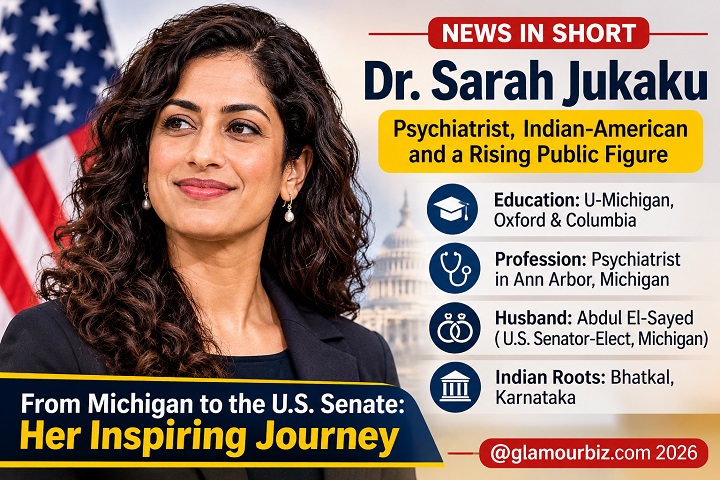
Dr. Sarah Jukaku, an American psychiatrist of Indian origin, has attracted attention following her husband Abdul El-Sayed's historic victory in Michigan's 2026 U.S. Senate election. Her professional achievements and Indian heritage have brought her into the spotlight following her husband's political success.
Sarah Jukaku: The Psychiatrist Behind Michigan's New Senator
When a Senate race ends, the conversation usually stays on the candidate: the speeches, the rallies, the promises. But now and then the person standing a step behind him turns out to be the more interesting story. That's what happened with Dr. Sarah Jukaku.
Jukaku is a psychiatrist, which her husband's campaign website confirms. She is married to Abdul El-Sayed, the Democrat who, according to news reports, beat Republican Mike Rogers in Michigan's US Senate race on November 3. Her job has little to do with campaign strategy. She works in mental health. She sits across from patients and listens for a living, and that kind of work doesn't come with a spotlight.
Through the campaign she kept things low-key. She didn't do a string of interviews or grab the microphone at rallies. She turned up at events, like one in Ferndale in late July and the March of the Many in Detroit in early August, and walked beside her husband rather than in front of him. On election night she was at the watch party in Detroit with him.
Then the results came in, a few photos made the rounds, and suddenly a lot of people were typing her name into search bars. Most of them wanted the same thing: who is she, exactly?
Who Is Sarah Jukaku? Meet Abdul El-Sayed's Wife
Let's start with the basics. Sarah Jukaku was born in the United States, and her parents emigrated from India. Profiles describe her as someone who grew up surrounded by doctors, so a career in medicine wasn't exactly a surprise.
Her family history leads to Bhatkal, a coastal town in the Uttara Kannada district of Karnataka. Her father, Dr. Jukaku S. Tayeb, grew up there. Her grandfather, J.H. Shamsuddin Jukaku, was a well-known local figure who served as a deputy minister. Indian news outlets picked up on all of this quickly, and the story spread fast online.
The love story starts at the University of Michigan. She and El-Sayed met as students, and by most accounts it didn't take long for him to know what he wanted. He proposed while she was in her first year of university. They married in May 2006, when she was 19. That's young by any standard, and it means they've now spent about two decades together, most of it before anyone outside their circle knew either name.
They have two daughters, Emmalee and Serene, and the family lives in Ann Arbor. In his book *Healing Politics*, El-Sayed wrote warmly about his wife's calm, grounded way of dealing with emotions, a contrast to how he described his own struggles. It's a small detail, but it says something about how he sees her.
One more point worth making. The marriage itself is a very American story. He is the son of Egyptian immigrants and a Muslim. She comes from a South Asian family. Plenty of commentators have noticed that, and plenty of couples in the US will recognize it from their own lives.
Sarah Jukaku: Her Family, Her Career and Her Husband's Senate Win
Running for office puts a family under a microscope, and Jukaku's career ended up under it too. During the campaign, the Washington Free Beacon reported that her private practice doesn't accept Medicare or any other insurance, so patients pay out of pocket. El-Sayed campaigned on Medicare for All, a single-payer system meant to cover every American, so the contrast got attention. Several conservative outlets ran with it, and at least one former Democratic adviser said it was a problem for progressives.
It's a fair thing for people to discuss. It's also worth keeping some perspective. Many psychiatrists run cash-only practices, often because insurance paperwork and reimbursement rates are a hassle in mental health care. Supporters of El-Sayed could reasonably argue that a doctor's choices inside the current system say little about what her husband wants the system to become. Critics will say the optics speak for themselves. Both views are out there, and readers can decide for themselves. I haven't seen Dr. Jukaku address the question publicly in detail.
The attention didn't stay on her work. President Donald Trump posted a side-by-side photo on Truth Social showing himself and Melania next to El-Sayed and Jukaku, with a caption about two very different Americas. Mother Jones reported that attacks on El-Sayed went after his family too, including his wife and his half-sister, writer and University of Chicago professor Eman Abdelhadi.
That's a lot to take on when your own job doesn't involve public life. She didn't sign up to be a political figure, and yet there she was in the middle of one of the most closely watched Senate contests of the cycle.
Her husband's win, as reported, is also a milestone for the family. Several outlets say he is the first Muslim elected to the US Senate. That claim comes from secondary coverage, so anyone writing about it should confirm it with an official source or a major wire service.
Sarah Jukaku Steps Into the Spotlight After Husband's Senate Win
Jukaku has kept her public presence small, and nothing I found suggests she plans to change that. Coverage has mostly described her as someone who stayed out of the limelight during the race. If her profile grows, it will probably be because other people keep writing about her, not because she goes looking for attention.
India has been especially curious. Outlets across Karnataka and beyond have written about her ties to Bhatkal, and her name went viral on social media within a day or two of the result. For a small coastal town, having a native family connected to a US Senate seat is a big moment. Local news even dug into her grandfather's history in the town, which gives you a sense of how proud people there feel.
There are real unknowns. Will she keep her practice in Michigan? How will the family handle a husband who's now a national figure? Will she start speaking more in public? None of that has been answered, and it wouldn't be fair to guess. What's clear is that a woman who spent most of her adult life outside politics now has a front-row seat to it.
Maybe that's the most human part of the story. She's a doctor, a mother of two, and a wife of twenty years, and she found herself in the headlines mostly because of who she married. Whatever she decides to do with the attention, her story already has plenty in it: a college romance, an immigrant family, a medical career, and a town in India that's watching closely.